

18
Apr, 2025
Model-Based Design Tools for Motor Control Development: A Comprehensive Overview
Rakesh K Dhawan, Power Electronics Group LLC
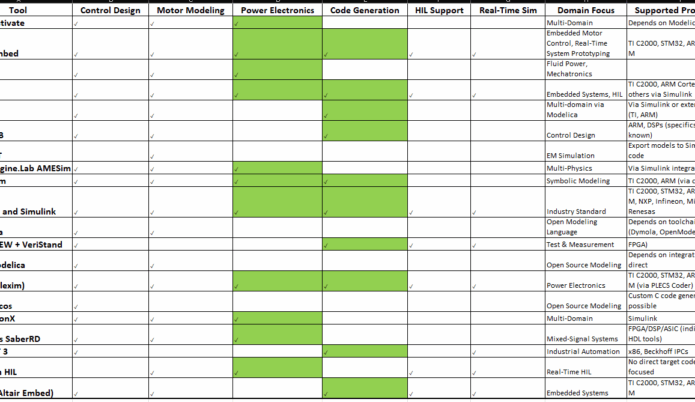
In today’s fast-paced world of electrification, motor control development is no longer limited to low-level coding and manual testing. Model-Based Design (MBD) has emerged as a game-changing methodology, enabling rapid prototyping, simulation, control validation, and automatic code generation. Various software tools now cater to different aspects of motor control development, from algorithm design to hardware-in-the-loop (HIL) testin...
Read More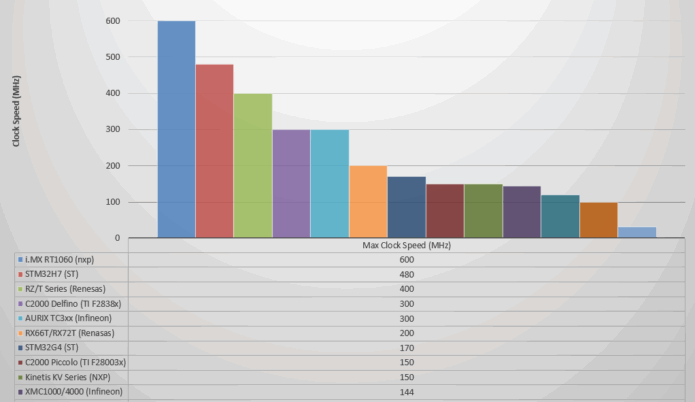
18
Apr, 2025
Choosing the Right Processor for Motor Development: A Comprehensive Guide
Rakesh K Dhawan, Power Electronics Group LLC
⚠️ Lessons Learned: The Hidden Cost of Picking the Wrong MCU Semiconductor companies often excel in marketing, even for their lower-end 8-bit MCUs, making it challenging for developers to determine which MCU is best suited for motor control. It’s easy to be misled by claims that an MCU can do “everything” when, in reality, it may fall short in real-time control, peripheral performance, or toolchain support. ...
Read More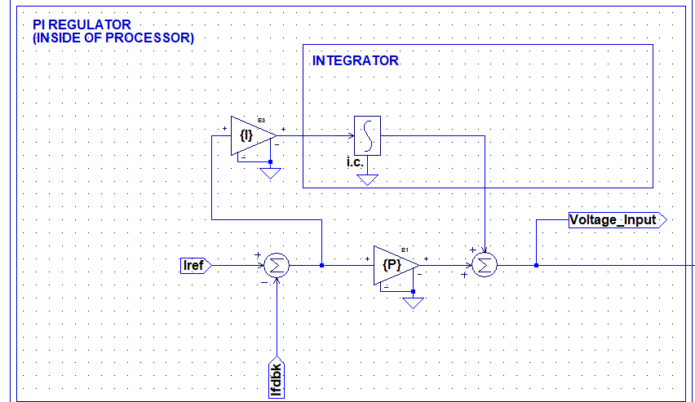
06
Apr, 2025
PMSM Sensorless Control Using a BackEMF Observer
Rakesh K Dhawan, Power Electronics Group LLC
Abstract This paper presents a sensorless control technique for Permanent Magnet Synchronous Motors (PMSMs) using a BackEMF observer. Eliminating physical position sensors improves system reliability and reduces cost and complexity. The proposed method estimates the back electromotive force (BackEMF) by comparing actual and estimated motor current and processing the error through a Proportional-Integral (PI) controller. This techniq...
Read More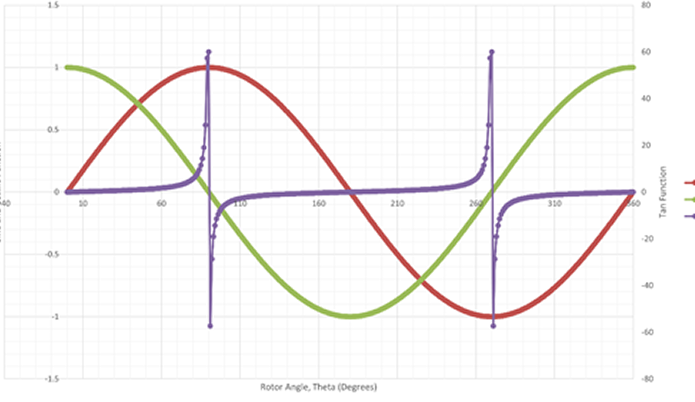
22
Mar, 2025
Converting Motor RPM into a 0-to-360-degree ramp signal
Rakesh K Dhawan, Power Electronics Group LLC
Converting Motor RPM into a 0-to-360-degree ramp signal Rakesh K Dhawan, Power Electronics Group LLC Converting Motor RPM into a 0 to 360-degree rampDownload 1.0 Abstract This article presents a method to convert motor rotational speed (RPM) into a continuous ramp signal spanning 0 to 360 degrees, utilizing LTspice for simulation and implementation. The approach starts with foundational mathematical equations that translate...
Read More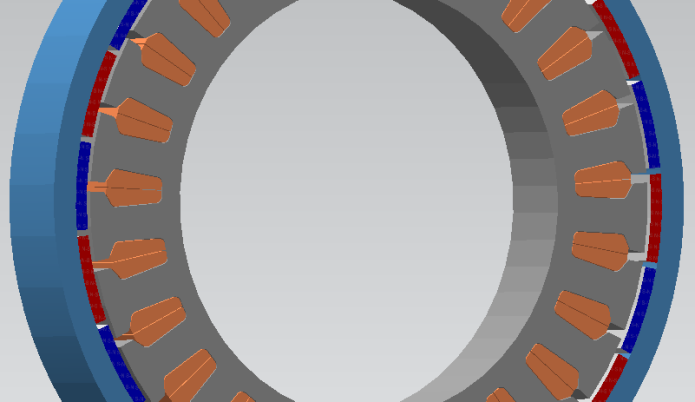
07
Mar, 2025
Understanding Permanent Magnet Motors
Rakesh K Dhawan, Power Electronics Group LLC
Let us assume we have a 5-phase motor we are trying to analyze. This motor has the following characteristics. Figure 1 - 5-Phase Motor with 22 Magnets and 25 Slots. OD of 200mm and Stack of 25mm. Motor Characteristics:Input Voltage = 48VMax Phase Current = 40APhase Resistance = 0.22 OhmsPhase Inductance = 1.5mH The motor's backEMF is shown below at 100 RPM. It is slightly trapezoidal compared to the Sinusoidal representation....
Read More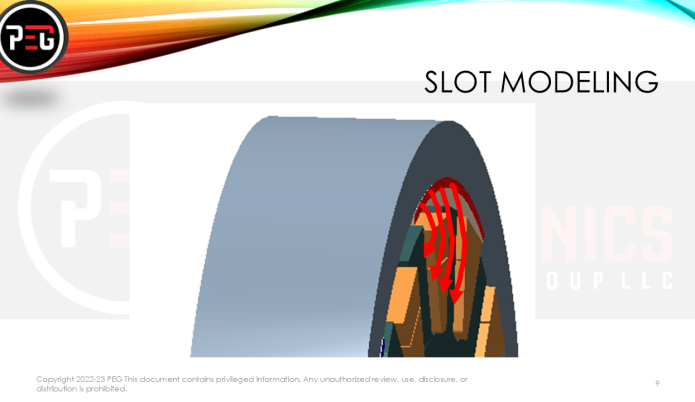
23
Feb, 2025
Minimizing Air Gap and Slot Width: Balancing Performance and Manufacturability
Rakesh K Dhawan, Power Electronics Group LLC
Rakesh Dhawan, BTech, MSEE, MBA In brushless permanent magnet (PM) motors, the air gap is crucial in determining motor efficiency, torque production, and overall electromagnetic performance. Ideally, a smaller air gap is preferred because it results in higher magnetic flux density, stronger coupling between rotor and stator, improved efficiency, and reduced weight. However, in practical applications, manufacturing limitations and me...
Read More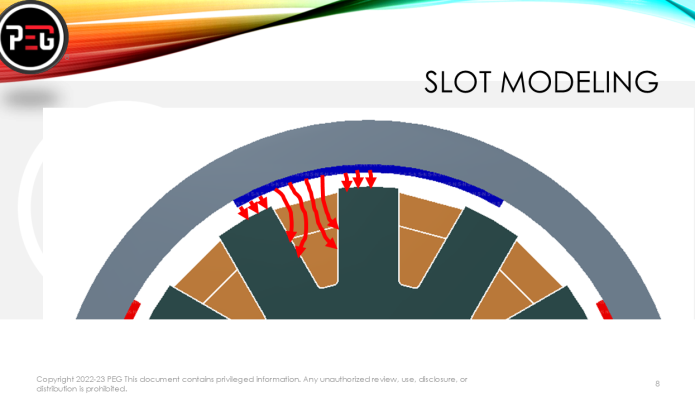
23
Feb, 2025
Analytical Methods for Brushless Permanent Magnet Motors - Slot Modeling
Rakesh K Dhawan, Power Electronics Group LLC
Rakesh Dhawan, BTech, MSEE, MBA In brushless permanent magnet (PM) motor design, accurate modeling of the air gap is critical for predicting magnetic field distribution and optimizing motor performance. One of the key challenges in slot modeling is the effect of slot openings on the effective air gap. Due to the presence of stator slots, the magnetic field distribution in the air gap is not uniform, and flux tends to bulge outward b...
Read More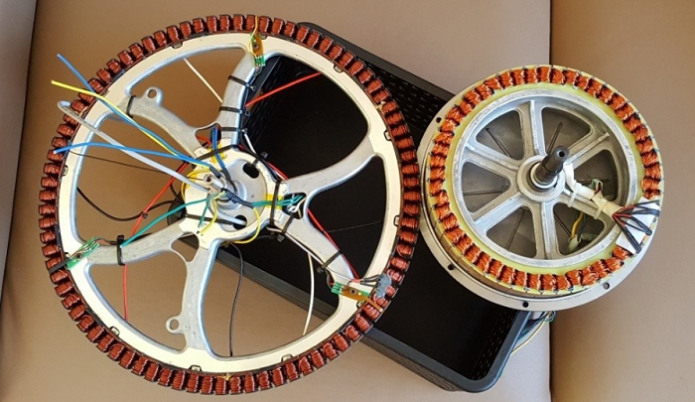
18
Feb, 2025
Effects of a Large Air Gap in Thin Stack Motors
Rakesh K Dhawan, Power Electronics Group LLC
Rakesh Dhawan, BTech, MSEE, MBA Think stack motors are rarely encountered. However, they do exist. BionX, an erstwhile Canadian Company, launched one of the known thin-stack motors in the field of electric bicycles. The large diameter motor with a 12mm stack height had some unusual characteristics. I will discuss that design in a separate post. Some of the concerns below are about thin stack motors. Increased Magnetizi...
Read More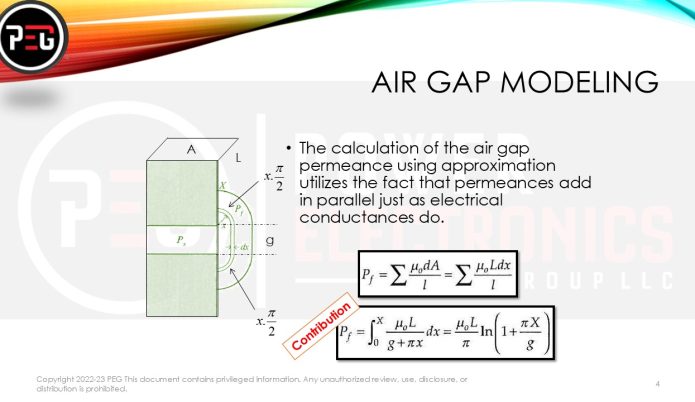
18
Feb, 2025
Analytical Methods for Brushless Permanent Magnet Motors - Air Gap Modeling
Rakesh K Dhawan, Power Electronics Group LLC
Rakesh Dhawan, BTech, MSEE, MBA Abstract Due to their efficiency and reliability, Brushless Permanent Magnet (PM) Motors are widely used in high-performance applications. This paper explores analytical methods for modeling and designing such motors. It discusses key aspects like air gap modeling, slot modeling, core loss analysis, and permanent magnet circuit modeling. These analytical techniques help optimize motor performance a...
Read More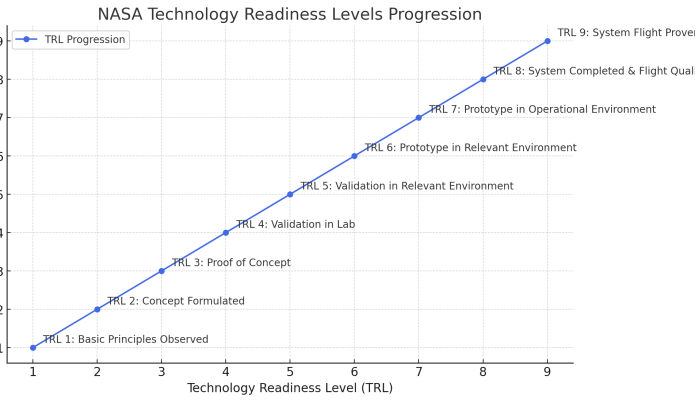
16
Feb, 2025
Understanding Feasibility Studies: Turning Ideas into Reality
Rakesh K Dhawan, Power Electronics Group LLC
Every great innovation starts with an idea—but how do you determine whether that idea can be transformed into an actual, functional product? This is where a feasibility study comes into play. A feasibility study is a structured approach to evaluating whether an idea is viable, focusing on technical know-how, proof of concept, and feasibility demonstration. 1. What is a Feasibility Study? A feasibility study answers ...
Read More